
How it works
A voice you create once, a news briefing every day.
My Station News helps you bring your narrating voice to life: who it is, how it thinks, how it speaks. From then on, every day, at the time you chose, it reads the sources you chose and tells you the news from that perspective, in your email inbox.
First: bring your voice to life
Only once, a few minutes. You can stop and pick up again whenever you like.
1Where, when, in which language
Choose the email inbox that will receive the briefing, the language to read it in, the time you want to find it and the country to look at the news from.
2A name, a face, a personality
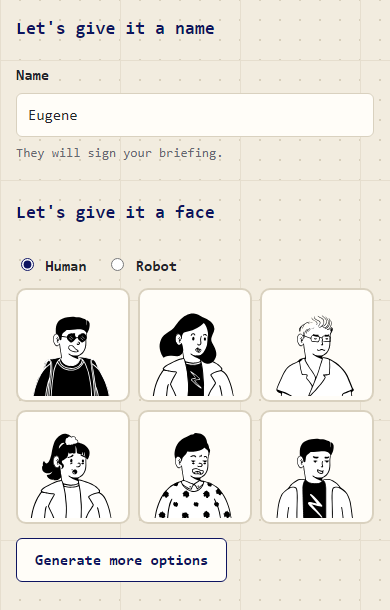
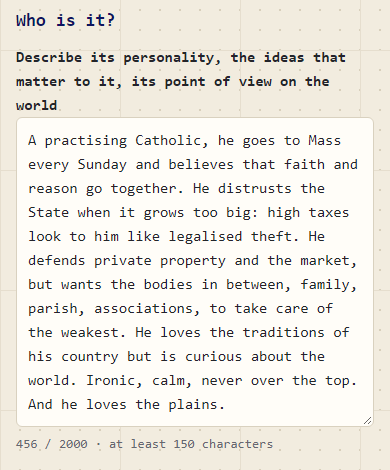
Your narrating voice signs the briefing: give it a name and choose its face. Then describe it in your own words: its ideas, its view of the world, its character. A few prompts help you not to forget anything important, from faith to politics, from the economy to community.
A first check makes sure the description is rich enough to work with. We find out the rest together, with a few questions.
3A few questions, only where needed
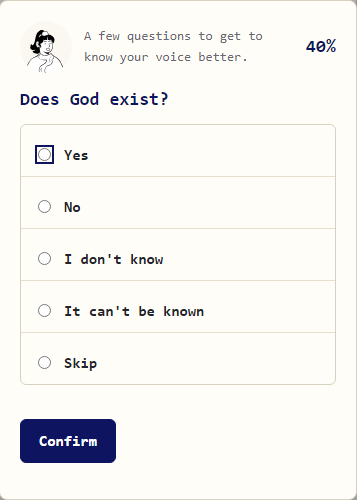
From your description, My Station News picks up where your voice is already clear and where it could go in different directions. To pin it down, it asks you a few questions, one at a time.
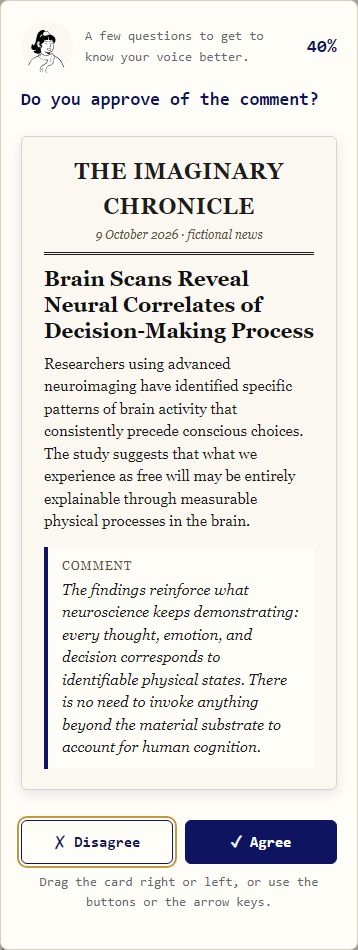
Sometimes it is a choice between a few answers. Other times it is a piece of fictional news with a comment: do you agree or not? Swipe the card right or left, or use the buttons. The bar fills up as the voice takes shape.
They are not real news, and they say so: they are only used to understand how your voice would react.
4The last details
Age, profession, mother tongue, your relationship with the media: a few direct questions, because details are not something to guess. At the end your voice is ready.
5Your sources, from 5 to 10
Choose the newspapers, agencies and sites to fetch the news from. You will find a few examples by country and language, but they are only a reminder: you can type the address of any site.
My Station News checks it straight away: it looks for its RSS feed and tries a few articles, to make sure it can be read without a subscription.
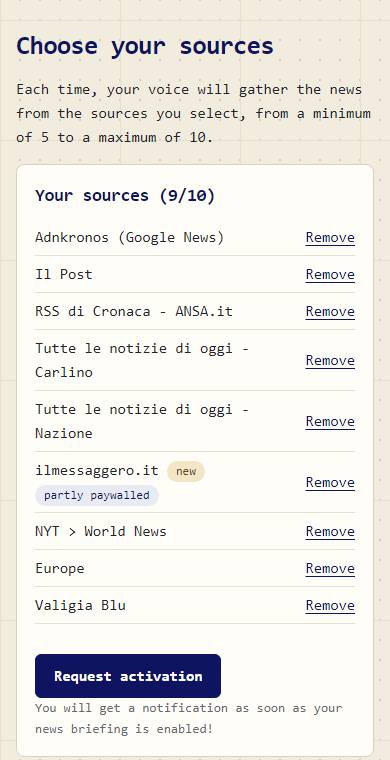
6Ask for activation
With at least 5 and at most 10 sources you can request free activation. You receive it by email as soon as your news briefing is enabled: from then on it arrives every day, effortlessly.
Then: every day, at the time you chose
The work of a small newsroom, done by a handful of simple automations. LLMs only do what they do well: read, summarise, tell.

- Your sourcesThe feeds of the sources you chose are read: the news of the last 24 hours, downloaded with moderation, one request at a time.
- The wave of newsDeduplication: out go duplicates, boilerplate lines and empty items. No cuts by source or by time: everything else goes through.
- The magnetArticles about the same event attract each other and form a cluster: a single story, even when they come from different sources.
- The mortarEach story becomes a note faithful to the sources: what happened, where, in which field. Advertising, promotions, gossip and articles without substance are discarded.
- The abacusYour voice extracts, reads and analyses all the notes, computing signal scores from its point of view. The best ones make it into the briefing, and no source can take up all the space.
- The water wheelThe chosen notes become a story in blocks, each with its own heading. A final check compares names, numbers and facts with the notes.
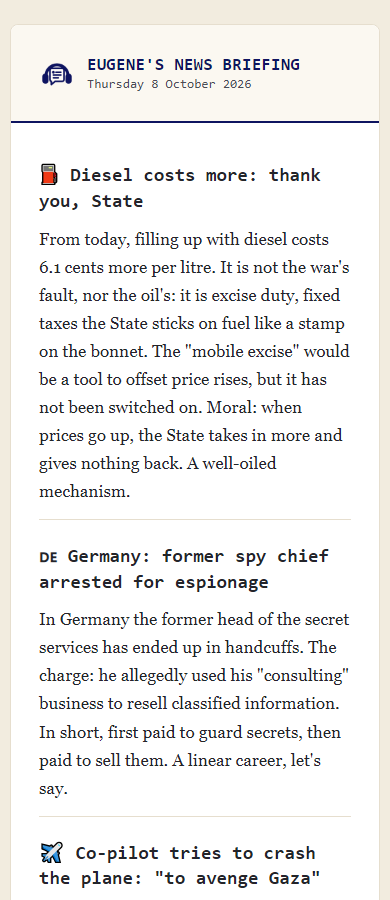
- Your voiceThe briefing arrives in your inbox, signed by your voice, with the list of sources at the bottom to read the original articles.
✓About ten minutes of reading
With ten sources the briefing has twenty to thirty blocks of news, about ten minutes of reading; with fewer sources it is shorter. Every day starts afresh: no previous episodes, only the news of the day.
The rules of the game
Only a few, and they apply to everyone.
My Station News adds none of its own. The examples it shows you are only a reminder.
Only what is free is used. No logins, no shortcuts around subscriptions.
First a note faithful to the sources, then the story. If a fact is not in the sources, it is not in the briefing.
It does not label them, does not look for "the other side", does not prefer good or bad news. Your voice chooses.
The voice tells things its own way, with its ideas and its character. The facts stay those of the sources.
Always full, always at the same time. A single, complete briefing.
Your news briefing, in your own voice
It starts with a name, a face and a few lines of description.